What soft washing actually is
Soft washing is low pressure water, usually under 500 psi and often closer to what comes out of a garden hose, combined with a cleaning solution designed to kill organic growth. The solution does the work. The water just applies it and rinses it off.
Pressure washing is the opposite approach. It uses mechanical force, typically 1,500 to 4,000 psi, to physically strip dirt, grime, and growth off a surface. No chemistry required. Just water moving fast enough to blast material loose.
Both methods clean. They are not interchangeable, and using the wrong one on the wrong surface is where most exterior cleaning damage happens. This page is the plain explanation of which method belongs where, why the difference matters more than most homeowners realize, and what it actually costs to get it done in Charlotte.
Why chemistry beats force on the surfaces that matter
Algae, mold, and mildew are living organisms with roots that anchor into a surface, not just a layer of dirt sitting on top. Blasting the visible growth off with high pressure removes what you can see but leaves the roots behind, which is why a pressure washed roof or a pressure washed section of siding often looks clean for a few weeks and then comes back looking worse than before, sometimes because the pressure roughed up the surface enough to give new growth something to grip.
A soft wash solution, typically a diluted sodium hypochlorite mix with a surfactant that helps it cling to vertical surfaces instead of running straight off, gets into that growth at the cellular level and kills it. There is no scrubbing and no blasting. The dead organic material rinses away with low pressure water, and because the roots are dead too, regrowth takes months instead of weeks.
This is also why soft washing tends to hold up longer between treatments than a pressure wash on the same surface, even though the upfront visual result looks similar the day the crew leaves.
What high pressure destroys
High pressure water is not a neutral cleaning tool. It is closer to a cutting tool once you push past a few hundred psi, and several common Charlotte building materials cannot take it.
Vinyl siding has seams and laps designed to shed rain, not withstand a direct pressurized stream. Pressure aimed at the wrong angle forces water behind the panels, where it sits against the house wrap and sheathing. That trapped moisture becomes hidden mold growth that nobody sees until a wall starts smelling musty or a panel starts warping.
EIFS and synthetic stucco, common on Ballantyne-era construction from the 1990s and 2000s, is a thin hard finish coat over a foam insulation board. It is not masonry. High pressure can puncture the finish coat outright, and even where it does not visibly break through, it can force water behind the system through seams and hairline cracks. EIFS is a sealed wall assembly, so once moisture gets behind it, there is no way for it to escape and dry out. That leads to rot and mold inside the wall that can go undetected for years.
Asphalt shingle roofing sheds its protective granules under direct high pressure. Those granules block UV light from breaking down the asphalt underneath, so stripping them shortens the life of the roof even though the roof looks clean immediately after.
Painted wood siding and trim can lose paint adhesion under pressure, especially at seams and corners, which means a pressure wash job can leave you needing a paint job you did not plan for.
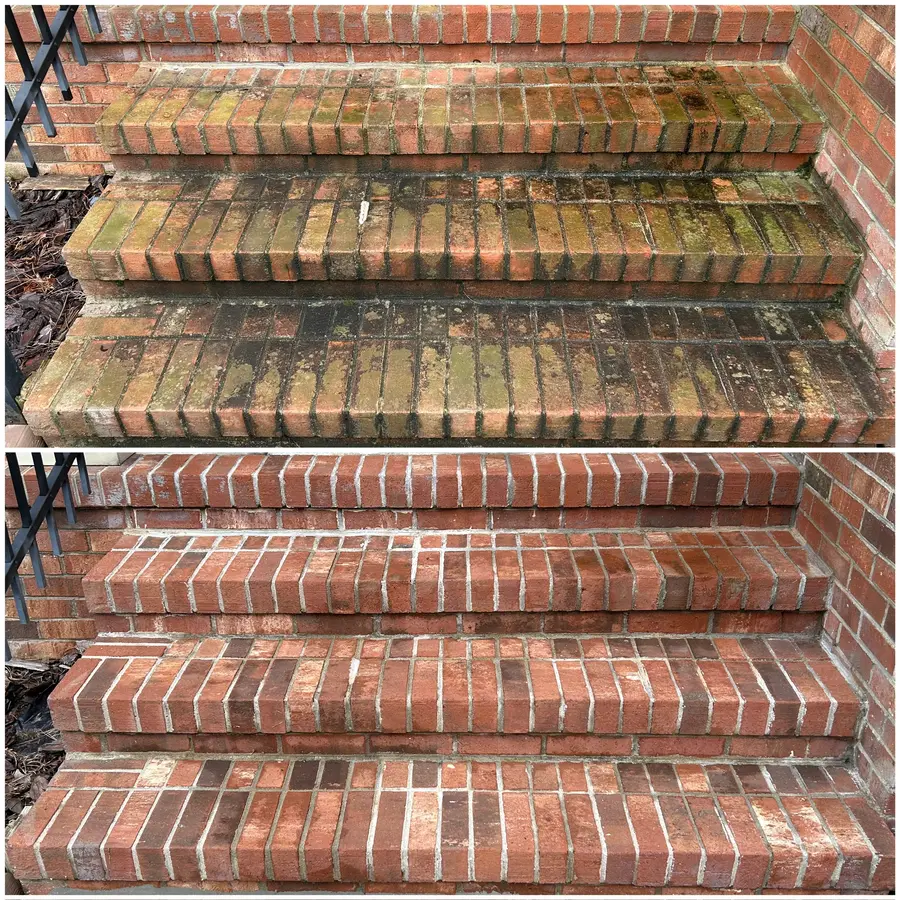
Unpainted historic brick, the kind found through Dilworth and Myers Park, is soft and porous by modern standards. The City of Charlotte’s Historic District Commission specifically caps cleaning at 200 psi on unpainted brick in locally designated historic districts, roughly equivalent to garden hose pressure, because higher pressure erodes the mortar joints and the brick face itself.
Surface by method
| Surface | Correct method | Why |
|---|---|---|
| Vinyl siding | Soft wash | High pressure forces water behind panels and into the wall assembly |
| EIFS and synthetic stucco | Soft wash only | Punctures the thin finish coat and traps moisture with no way to escape |
| Asphalt shingle roof | Soft wash only | The black streaking is Gloeocapsa magma, a cyanobacteria, so it has to be killed chemically. High pressure strips protective granules and shortens roof life |
| Painted wood siding and trim | Soft wash | Pressure lifts paint adhesion at seams and corners |
| Unpainted historic brick | Soft wash, 200 psi max | HDC standard for Dilworth and Myers Park to protect mortar and brick face |
| Hardie fiber-cement siding | Soft wash, moderate pressure acceptable | Durable but manufacturer guidance still favors low pressure with cleaning solution |
| Poured concrete driveway | Pressure wash, surface cleaner attachment | Bare concrete tolerates higher pressure without structural risk |
| Concrete or brick pavers | Pressure wash, moderate | Handles pressure but joint sand can wash out if pressure is too aggressive |
| Wood deck boards | Soft wash preferred, light pressure possible | High pressure raises the wood grain and can gouge softer boards |
One clarification on surface cleaners
A surface cleaner is not a gentler setting. It is an attachment, a housing with spinning bars that runs the same pressure your wand does and simply spreads it evenly across a wide path. The reason we use one on concrete is not that it is softer, it is that a wand leaves racing stripes and a surface cleaner does not. Anyone describing a surface cleaner as a low-pressure method is describing the tool wrong.
Concrete is where chemistry still matters
Bare concrete tolerates pressure, but pressure alone does not touch two of the most common Charlotte problems. Piedmont red clay staining comes from iron oxide bonded into the pores of the concrete, and rust from irrigation heads and metal furniture behaves the same way. Neither is dirt and neither responds to bleach, soap, or more pressure. Both need an oxalic acid treatment applied and dwelled before any pressure pass. See rust and stain removal for how that sequence actually runs.
Why this matters more in Charlotte specifically
Charlotte’s Piedmont climate runs humid enough, averaging 59 to 74 percent relative humidity with a July and August peak, to drive real algae and mildew growth on shaded surfaces, especially north-facing walls under mature tree canopy in neighborhoods like Myers Park and Dilworth. That growth is exactly what soft washing is built to kill at the root rather than temporarily strip.
At the same time, Charlotte’s housing stock spans three distinct eras that each demand a different answer. The 1990s through 2000s suburban boom in Ballantyne and Highland Creek built heavily with EIFS. The pre-1930s streetcar suburbs of Dilworth and Myers Park carry original wood and brick under HDC jurisdiction. The newer construction corridors in Steele Creek and Berewick lean on Hardie fiber-cement and vinyl. A crew that treats all three the same way is going to get one of them wrong.
What it costs
Soft washing is not priced as a standalone line item the way house washing or roof cleaning are. It is the method, and the price attaches to the specific service, whether that is house washing, roof cleaning, or fence cleaning, each of which has its own typical range. See the individual service page for a specific number.
What generally moves the price on any soft wash job:
- Square footage and number of stories. More surface area and ladder work for upper stories both add time.
- Severity of buildup. A home that has never been washed needs a stronger solution mix and a second pass more often than one on a regular schedule.
- Surface type. EIFS and historic brick require more careful, slower application than vinyl or Hardie siding.
What goes wrong when soft washing is skipped or done badly
The most common mistake is a company advertising “soft wash” but running the same pressure washer with a chemical injector at too high a pressure setting, which defeats the purpose and still risks the damage this page describes. Ask what psi they run on siding specifically, not just whether they use chemicals.
The second most common mistake is skipping the pre-rinse or post-rinse step to save time, which leaves dead algae residue and a faint chemical smell that lingers for days. A proper soft wash job rinses thoroughly at low pressure after the dwell time on the solution, not just a quick pass.
The third is under-diluting the solution to get a faster visual result. That gets you a whiter looking wall today and a higher chance of streaking, plant damage, or surface discoloration within a week.