Red clay is not dirt, and treating it like dirt is why it does not come off
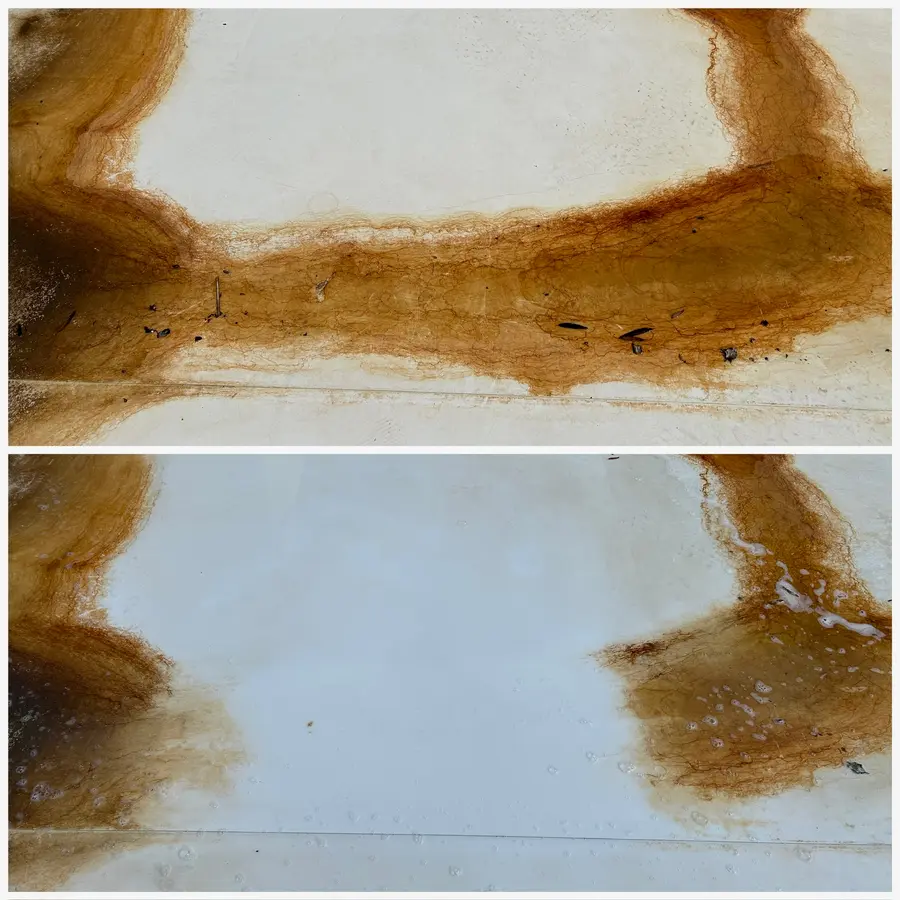
If you have lived in Charlotte for more than a season, you have seen the stain. An orange-red discoloration on a driveway, a walkway, a patio, sometimes streaking down a foundation wall, that does not respond to a garden hose, a broom, dish soap, or even a bottle of store-bought concrete cleaner. Most homeowners assume it is dirt that just needs more scrubbing, or mildew that needs bleach. It is neither, and understanding why changes what actually works.
The Piedmont region that Charlotte sits in has a soil type called Cecil soil, and Cecil soil is heavy in kaolinite clay. That clay carries a naturally high iron oxide content, the same mineral compound that gives rust its color. When rain, foot traffic, tire treads, or landscaping runoff carries that clay onto a concrete surface, the iron oxide does not just sit on top the way ordinary dirt does. It bonds chemically with the concrete, particularly on unsealed or porous concrete where the clay particles work their way into the surface pores.
This is why every homeowner’s first instinct fails. Bleach and soap are built to break down organic material, biological growth like mold, algae, and mildew, or general grease and grime. Red clay staining is a mineral bond, not an organic one, so those products have nothing to react with. Pressure alone fails for a similar reason. You can blast the surface clay particles away, but the iron oxide that has already bonded into the concrete’s pores stays behind, and pushing harder with more pressure often just etches the concrete surface instead of removing the stain, leaving a rough patch that looks lighter but feels different underfoot and stains again faster than before.
What actually breaks the bond
Oxalic acid is the chemistry that works here, and it works because it reacts specifically with iron oxide, converting it into a soluble compound that can then be rinsed away with low pressure water. This is the same reason oxalic acid based products are the standard fix for actual metal rust stains, since chemically, red clay staining and rust staining share the iron oxide component that oxalic acid targets.
The sequence matters. Chemical treatment has to happen first, with enough dwell time on the surface to fully react with the iron oxide before any water touches it. Rinsing too early, or trying to speed the process along with a scrub brush before the chemical has finished working, undoes progress and can spread the stain instead of lifting it. Pressure comes in only at the end, and only to rinse the loosened, converted material off the surface, not to do the actual cleaning work.
Porous or unsealed concrete needs a longer dwell time and sometimes a second application, since the staining has worked deeper into the surface. Sealed concrete and denser pavers usually respond faster because the clay never had the chance to penetrate as deep.
Why this is the biggest gap in local search right now
As of this writing, a search for how to remove red clay stains from concrete in the Charlotte area returns exactly zero local businesses. Every result is a national chemical manufacturer’s blog post or a generic home improvement site. That is unusual for a problem this common and this regionally specific. Red clay staining is practically a regional identity marker in the Piedmont, and it is one of the most frequent complaints homeowners in Ballantyne, Steele Creek, Berewick, and the Union County subdivisions bring up about their driveways, yet nobody local has written the definitive answer. That gap is exactly why this page exists.
Irrigation rust, fertilizer stains, and metal furniture rust
Red clay is the biggest driver of orange staining in this market, but it is not the only one, and the treatment overlaps enough that it is worth covering the others here.
Irrigation system rust shows up as rings or arcs around sprinkler heads, usually from iron content in well water or corroding galvanized fittings. It responds to the same oxalic acid treatment, often with a shorter dwell time since the staining is typically shallower and more recent than long-tracked clay.
Fertilizer stains come from iron-based lawn fertilizers that spill or get tracked onto a walkway or driveway edge before they wash into the grass. Same iron oxide chemistry, same treatment, though fertilizer stains tend to sit right at the surface and lift faster than either clay or true rust.
Outdoor metal furniture rust transfers onto a pool deck or patio surface where a rusting chair leg or table base has sat in one spot, often for months, leaving a stain shaped exactly like the furniture footprint. These can be some of the most stubborn stains we see because the metal keeps re-depositing rust in the same spot every time it rains, so the surface treatment has to be paired with either sealing the concrete or getting the furniture off bare metal contact, using proper feet or a mat, to stop it from recurring.
What it costs and what actually moves the price
We do not publish a flat number here because rust and clay staining varies more job to job than almost any other service we offer. What determines the cost:
- Which source is staining the surface. Piedmont clay tracking across a whole driveway takes more chemical volume and time than a single sprinkler ring or one furniture footprint.
- How porous the surface is. Unsealed concrete, natural stone, and older unsealed pavers absorb staining deeper and need longer dwell time or a repeat application, compared to sealed concrete or dense modern pavers.
- How long the staining has been there. A stain that has tracked in for years bonds deeper than one from a single rainy season, and older staining sometimes needs two treatment passes.
- Total square footage affected. A full driveway is priced differently than a single walkway or one patio corner.
We will walk the affected area, tell you honestly whether it is one treatment or likely two, and give you a number before we start. If we are not confident in an exact figure over the phone, we would rather look at it in person than guess.
Charlotte’s climate keeps this problem coming back
Red clay staining is not a one-time fix and forget situation here the way it might be in a region with less iron-rich soil. Piedmont clay is everywhere under the topsoil across the Charlotte metro, and every heavy rain event, every landscaping delivery, every truck or mower tire that tracks through a muddy yard edge carries a fresh supply onto your hardscape. Sealing the surface after treatment is the single biggest thing that slows the return, since it closes the pores the clay would otherwise bond into again, but it is not a permanent seal against a soil type this pervasive.
What goes wrong when this is done badly
The most common mistake we see from other companies, and from DIY attempts, is skipping the chemical step entirely and going straight to high pressure, which either fails outright or etches the concrete trying to force a result the pressure alone cannot deliver. The second is using the wrong acid concentration or dwell time for the surface, which on natural stone or certain paver finishes can etch or discolor the material itself. The third is treating a large stained area with a single light pass instead of accounting for how deep older staining has actually penetrated, leaving a faint ghost of the stain that customers understandably read as a failed job rather than a job that needed a second application.