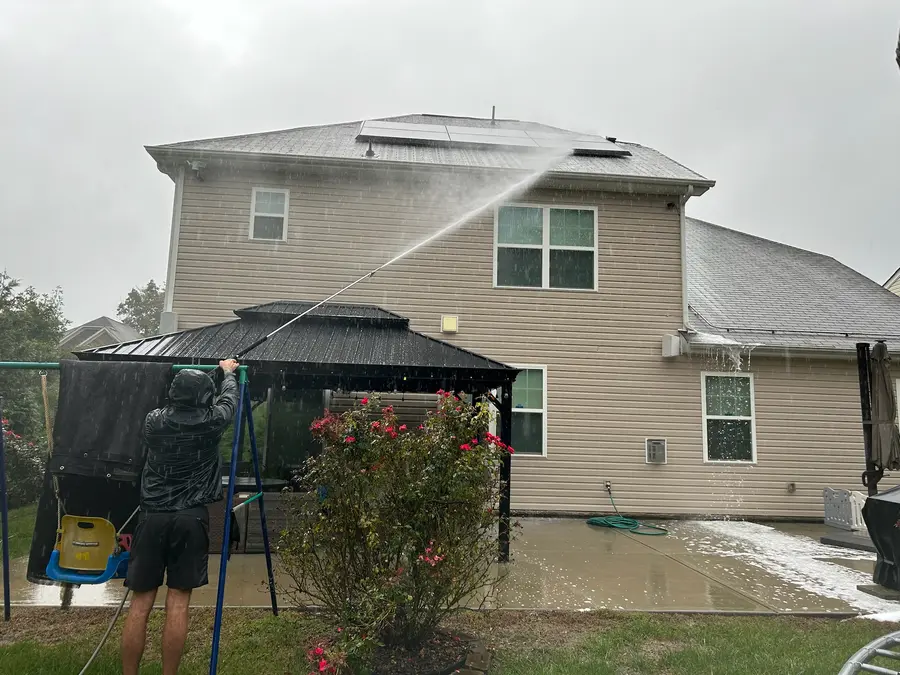
Why roof cleaning is never a pressure washing job
An asphalt shingle roof is built with a granule layer bonded to the surface. Those granules block UV light and shield the asphalt underneath from breaking down in direct sun, and they are what gives the roof its color and its expected lifespan, typically 20 to 30 years for architectural shingles when the granule layer stays intact.
High pressure water strips that granule layer off. A pressure washed roof looks dramatically cleaner the day the job finishes, but it has lost protection it cannot get back, and shortened its own service life to do it. Most major shingle manufacturers explicitly prohibit high pressure washing in their warranty documentation for exactly this reason. Any company offering to pressure wash your roof is either unaware of this or not telling you.
Soft washing is the correct method, full stop, on any asphalt or architectural shingle roof. Low pressure, close to garden hose force, paired with a cleaning solution that kills the biological growth causing the discoloration in the first place.
What is actually growing on your roof
The dark streaking most homeowners describe as dirt or mold is usually gloeocapsa magma, a blue-green algae that feeds on the limestone filler compound in asphalt shingles. It typically starts on north-facing slopes and in shaded valleys where moisture lingers longest after rain, and it spreads as spores travel between roofs on wind and by birds, which is why an entire street sometimes seems to develop streaking around the same time.
Moss is a separate and more serious problem. Where algae streaking is mostly cosmetic in its early stages, moss holds moisture directly against the shingle surface and can work its way under shingle tabs and edges over time, raising the risk of actual water intrusion rather than just discoloration. Moss concentrates in the same shaded valleys and near chimneys, vents, and skylights where debris collects and stays damp.
Lichen is the toughest of the three to treat, since it bonds more aggressively to the shingle surface than algae or moss, and it often needs a longer chemical dwell time and sometimes a repeat treatment to fully clear.
How the soft wash treatment works
A roof cleaning crew applies a low pressure cleaning solution, typically a diluted sodium hypochlorite mix with a surfactant that helps it cling to a sloped surface instead of running straight off, and lets it dwell long enough to kill the algae, moss, or lichen at the root. There is no scrubbing and no aggressive rinsing. The solution does the work, and a gentle low pressure rinse removes the dead organic material afterward.
Because the roots die along with the visible growth, a properly soft washed roof stays clean noticeably longer than one that was pressure washed or scrubbed, which only removed what was on the surface.
How often Charlotte roofs actually need this
Roof cleaning holds up longer between treatments than siding does, generally 2 to 4 years, because shingle granules retain the cleaning solution better than a smooth surface like vinyl or Hardie board. Where you fall in that range depends heavily on shade and slope orientation. A roof with significant tree canopy overhead in older neighborhoods like Myers Park or Dilworth, or a roof with several north-facing slopes and valleys, tends toward the shorter end. A roof with mostly southern and western exposure and minimal overhanging canopy, common in newer construction corridors like Steele Creek and Berewick, can often stretch toward the longer end.
Charlotte’s Piedmont humidity, averaging 59 to 74 percent with a July and August peak, is enough moisture to sustain algae growth on shaded roof sections year round, which is why the shade factor matters more here than the season.
What it costs and what moves the price
Most Charlotte roof cleaning jobs run $400 to $800. Two things determine where a specific roof lands.
Size, pitch, and story count. A steep pitch or a two-story home requires more safety setup, harnesses, roof anchors, and time, than a single-story home with a shallow pitch. Larger roofs simply need more solution and more time to treat and rinse thoroughly.
How much growth has built up. A roof that has never been cleaned, or one with heavy moss concentrated in shaded valleys, needs a stronger solution mix and often a longer dwell time or a second targeted application on the worst sections, compared to a roof on a regular treatment schedule that only shows light streaking.
We inspect the roof, note which slopes have the heaviest growth and whether moss has established rather than just algae, and give you a firm price before starting.
What to expect on the day
A crew sets up safety equipment appropriate to the roof pitch, applies the cleaning solution starting at the ridge and working down so it has full dwell time on every section, and does a low pressure rinse once the solution has had time to work, usually 15 to 20 minutes depending on growth severity. We take care around gutters, downspouts, and any landscaping directly below roof edges, since runoff carries the solution and the dead organic material with it.
Most roof cleaning jobs take two to four hours depending on size and growth severity. You do not need to be present.
What goes wrong when roof cleaning is done badly
The most damaging mistake is a crew using a pressure washer on the shingles at all, whether they call it soft washing or not. If a company cannot tell you the psi they run against shingles, or if you see a wand making direct contact with the roof surface rather than a low pressure sprayer application, that is pressure washing regardless of what it is called on the invoice, and it will strip granules.
The second mistake is insufficient dwell time, rinsing the solution off before it has fully killed the algae or moss roots, which leaves a roof that looks clean for a few weeks and then streaks again faster than if it had been left alone, since the surface disruption from a rushed rinse can actually give new spores something to grab onto.
The third is ignoring moss specifically and treating it the same as surface algae. Moss needs a longer dwell time to kill fully, and a rushed treatment can leave dead moss that still holds moisture against the shingle even after the color fades, which continues the water intrusion risk the treatment was supposed to solve.