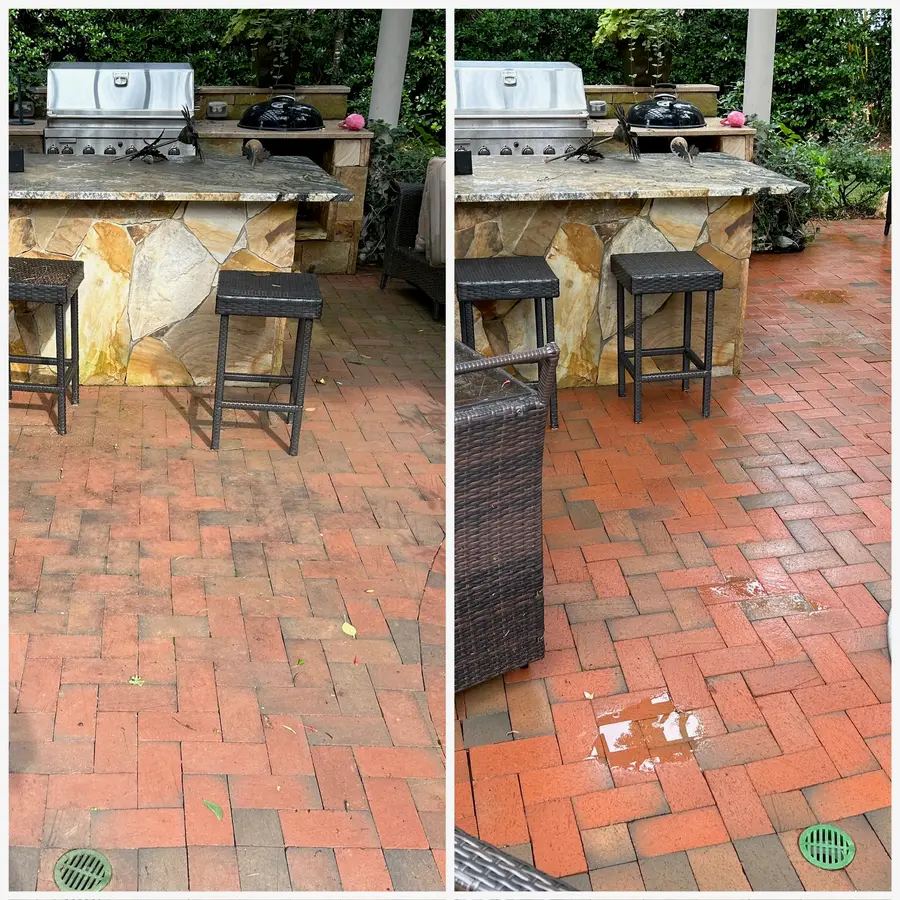
Why paver cleaning is not the same job as cleaning a plain concrete slab
Pavers, whether concrete, brick, or natural stone, are individual units set into a bed of sand with sand-filled joints between each piece, not a single poured surface. That structural difference changes how cleaning has to be approached. A plain concrete driveway can take a stronger, more direct pressure pass because it is one continuous slab with nowhere for water to disturb structural material. Pavers have joints, and those joints are exactly what pressure aimed the wrong way damages.
Why pressure has to stay moderate on pavers
Running a pressure washer directly into the joints between pavers at too high a setting blasts the joint sand out. That sand is not decorative. It is what keeps individual pavers locked in place and prevents them from shifting, rocking, or settling unevenly under foot traffic or vehicle weight. Once enough joint sand washes out, pavers start moving independently of each other, which is both a tripping hazard and the start of a larger, more expensive repair than a cleaning job should ever create.
The correct approach angles pressure across the paver surface rather than straight down into the joints, and keeps the pressure setting moderate enough to lift dirt and grime without excavating the sand underneath. This is a meaningfully different technique than what a crew would use on a plain concrete driveway, even though both are technically pressure washing jobs.
Weeds are a joint problem, not a surface problem
Weeds growing up between pavers root in the joint sand, and pulling the visible plant almost always leaves the root system intact along with the seed bank already sitting in that sand. That is why the same spots keep sprouting weeds season after season no matter how often someone pulls them by hand.
A real fix means cleaning the joints out fully and replacing the sand, often with a polymeric sand product that hardens once it cures and resists both weed germination and ant activity far better than standard joint sand. This is separate labor from the wash itself, and it is one of the main reasons paver cleaning costs vary more than a simple flat concrete cleaning job does.
Red clay and rust staining on pavers works the same as anywhere else
Piedmont red clay, common across the Charlotte metro from Cecil soil, stains pavers the same way it stains a driveway, bonding chemically into porous surfaces through the iron oxide the clay carries. Natural stone and unsealed concrete pavers absorb this staining deeper than sealed pavers, and it needs the same oxalic acid based chemical treatment before any pressure pass that a driveway needs. Rust from irrigation heads or metal furniture on a paver patio or pool deck responds to the same chemistry.
Skipping the chemical step and relying on pressure alone to remove this kind of staining either fails outright or risks etching the paver surface, which is a permanent texture change rather than a cleanable stain.
Natural stone needs its own consideration
Concrete and brick pavers are manufactured to a consistent standard, but natural stone varies by type, and some stones react differently to chemical treatment than others. Certain natural stones can etch or discolor under an acid based treatment that would be entirely safe on concrete or brick, so identifying the specific stone before applying any chemical step matters more here than on manufactured pavers.
Pool deck pavers face a different set of conditions
Pavers around a pool deal with constant water splash, sunscreen and lotion residue, and regular exposure to pool chemicals, none of which a driveway or front walkway paver ever encounters. That combination changes what actually causes staining and buildup around a pool, and it affects which sealer products hold up well given chlorine exposure. A pool deck paver job is worth treating as its own consideration rather than assuming the same approach used on a driveway paver section will perform identically near the water.
Sealing after cleaning
Sealer typically needs reapplying every 2 to 3 years depending on how much direct sun and foot traffic a paver surface gets. Applying it right after a cleaning makes practical sense, since the surface is already free of dirt, old degraded sealer residue, and any staining that would otherwise interfere with a fresh coat bonding evenly. Sealing also meaningfully slows how fast red clay staining and new weed growth return, since it closes surface pores the clay would otherwise bond into and makes the joint area less hospitable to weed seeds.
What actually determines the cost
We do not publish a flat price here because paver jobs vary more than most services based on scope beyond just the wash itself.
- Total square footage and how many joints need attention. A patio with intact, weed-free joints costs less to service than one needing full resanding across the whole area.
- Whether sealing is part of the job. Sealer material and the additional dry time and application visit it requires add cost beyond a wash-only service.
- Staining type. Straightforward dirt and light algae is a faster job than red clay or rust staining that needs chemical pre-treatment before any pressure touches the surface.
We walk the paver area, check joint condition and staining type, and give you a scoped price that reflects exactly what that specific patio, walkway, or pool deck needs rather than a generic per-square-foot number that ignores joint condition entirely.
How often Charlotte pavers need attention
Most paver surfaces need a real cleaning once a year, similar to a driveway, though shaded sections near a house wall or under tree canopy develop mildew faster and may need spot attention sooner. Joint sand and sealer typically need refreshing on a longer cycle, every 2 to 3 years, unless heavy weed growth or visible sand loss shows up sooner.
What goes wrong when paver cleaning is done badly
The single most common and most expensive mistake is aggressive pressure straight down into the joints, which blasts out sand and starts a paver shifting problem that a homeowner may not notice until months later when pavers start rocking underfoot. The second is skipping chemical pre-treatment on red clay or rust staining and pushing pressure harder to compensate, which risks permanently etching the paver surface. The third is applying sealer over pavers that were not fully dry or still had residual staining, which traps that staining under the sealer coat and makes it far harder to address later without stripping the sealer first.