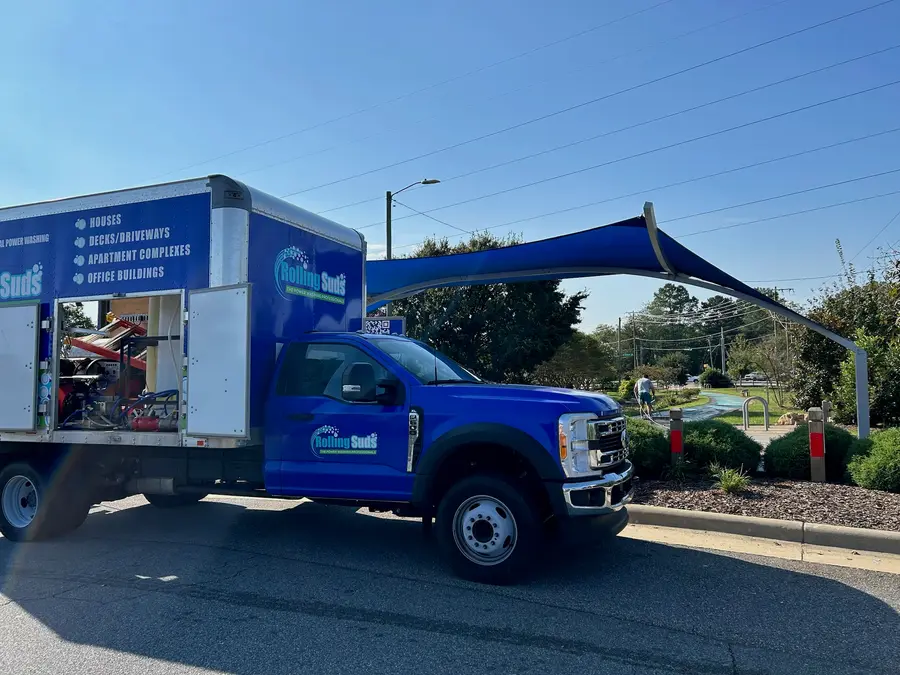
Fleet washing is a scheduling problem before it is a cleaning problem
Washing one truck is straightforward. Washing a fleet of fifteen, thirty, or more delivery vehicles, service trucks, or trailers is a logistics problem first. The vehicles need to be clean, but they also need to be back on the road or ready at the depot before drivers show up for their shift, and pulling trucks out of rotation to drive to an outside wash bay costs time and fuel that a fleet manager feels in the budget every month.
We solve for that by washing on site, at your depot or lot, on a schedule built around your dispatch times rather than ours. The cleaning itself, degreasing, rinsing, drying road film off panels and wheels, is not complicated. Making sure it happens without touching your operation is the part that actually matters to a fleet manager deciding between vendors.
On-site washing versus sending vehicles out
Some fleet operators still send vehicles to a commercial wash bay or truck wash facility, usually because that is how it has always been done. For a small number of vehicles with flexible schedules, that can work. For anything approaching a real fleet, on-site washing at your depot solves problems that off-site washing creates.
Sending a truck to an outside wash bay means driver time spent on something other than the route, a vehicle out of rotation during the drive and wait, and scheduling around the wash bay’s hours rather than your own. On-site washing removes all three. We show up with our own water supply and equipment, wash vehicles where they already park, and your drivers never leave the depot to get a clean truck. For fleets with a dozen or more vehicles, the math on driver time alone usually justifies the switch even before factoring in the convenience.
Building the schedule around route departure times
A fleet running early morning routes needs clean trucks ready well before the first departure, not a crew still working when drivers are trying to load and leave. We build the wash schedule backward from your actual dispatch times. If your first truck leaves at 5am, the wash happens the night before or in the very early morning hours with enough buffer that nothing is still wet or blocked in when a driver needs to pull out.
Fleets with staggered departure times, some trucks out at 6am, others not until midafternoon, get a schedule that works through the lot in the order vehicles are needed, so the ones leaving earliest get washed first. This takes some coordination on the front end, usually a short conversation about your typical dispatch pattern, but it means the wash schedule fits your operation instead of forcing your operation to fit around us.
Recurring schedules, and why most fleets end up there
A one-time fleet wash solves a one-time problem, a big event, an inspection, a client visit. Most fleet operators end up on a recurring schedule instead, because vehicles that run routes daily get dirty on a predictable cycle and a standing appointment is easier to manage than calling every time the fleet starts looking rough.
| Route type | Common wash frequency | Why |
|---|---|---|
| Local delivery, daily short routes | Weekly | Frequent stops, road film and dust build up fast |
| Regional or highway routes | Biweekly | Longer distance but fewer stop-and-go cycles |
| Service vehicles, on-site work | Biweekly to monthly | Job-site dirt and material residue varies by trade |
| Trailers, less frequently moved | Monthly | Slower buildup, but larger surface area per visit |
A recurring contract also locks your fleet into our schedule at a set time slot, which matters more than it sounds like once you have tried to book a one-off wash during a busy season and found the calendar full.
Water reclamation and where the runoff actually goes
Washing thirty trucks in one visit generates a lot more wash water than washing a single vehicle, and that volume matters for where it ends up. Depots often sit near loading areas, storm drains, or paved lots with limited absorption, which means runoff has somewhere obvious to go if it is not managed.
We direct wash water away from storm drains where the site layout allows, routing it toward grass, gravel, or a designated low point rather than letting it sheet across pavement into a drain that connects to a waterway. If your depot has a specific stormwater management requirement, tied to a permit, a lease, or a corporate environmental policy, tell us before the first visit and we will plan water flow to fit it. This is a bigger consideration for fleet washing than for almost any other commercial service we offer, simply because of the volume involved in cleaning many vehicles in a single visit.
What gets cleaned, and what does not
A standard fleet wash covers the exterior body, cab, and trailer panels, wheels, and the visible undercarriage where road grime and salt residue collect. Graphics and decals get treated carefully, since aggressive pressure or the wrong chemical can lift vinyl lettering or fade a wrapped design faster than normal wear would. If your fleet carries branded wraps, tell us at booking so we can confirm safe pressure and chemistry for that specific vinyl before the first wash.
We do not do interior cab cleaning, engine bay degreasing, or mechanical work of any kind. This is exterior washing, done thoroughly and on a schedule, not a full detailing service.
The ROI case for regular fleet washing
A fleet is a moving advertisement for your business whether it is branded with a logo or plain white, and its condition communicates something to every customer, every driver on the road, and every prospective employee who sees it at a job site or a delivery stop. A delivery fleet caked in road grime and old oil residue signals a company that does not sweat the details, and customers notice that even if they never say it out loud. For service businesses in particular, a clean truck pulling up to a customer’s home or business is doing quiet marketing work that a dirty one actively undermines.
There is a maintenance angle beyond appearance too. Road salt, oil residue, and general grime left on a vehicle exterior for extended periods accelerates corrosion on wheels, undercarriage components, and body panels faster than a regularly washed vehicle experiences. A recurring wash schedule is a relatively small expense against the alternative of accelerated wear on a capital asset that represents a meaningful chunk of a fleet operator’s budget.
Insurance and working on your property
Bringing a wash crew onto your depot regularly means that crew becomes a recurring presence on your property, which is different from a one-time vendor visit. We provide a certificate of insurance before the first visit and keep it current for the life of a recurring contract, so your risk management or operations team has what it needs on file without having to chase it down every time a policy renews. If your depot has specific site access rules, a sign-in process, or safety requirements for any vendor on the property, tell us during setup and we will build that into how the crew operates on every visit, not just the first one.
What moves the price
Fleet size and vehicle type set the baseline, since a box truck or straight truck takes meaningfully longer per unit to wash thoroughly than a cargo van or sedan, given the larger panel surface area and higher roofline involved. Wash frequency changes the per-visit price, since a weekly recurring contract prices differently than a single one-time wash, reflecting the standing commitment on both sides. Whether we are washing at your depot versus a different drop-off arrangement affects crew travel and setup time built into the quote. Trailers, undercarriage work, and vehicles with branded graphics needing extra care all add time beyond a standard exterior rinse.
Seasonal factors that change how often a fleet needs washing
Road grime accumulates differently across the year, and a fleet manager planning a wash schedule should account for that rather than assuming a flat interval works year round. Winter months bring road salt and treatment brine on routes that cross into areas where roads get treated, and that residue accelerates corrosion if left on a vehicle for weeks. Spring brings pollen, which coats every vehicle in a fleet the same way it coats a parked car in a driveway, sometimes heavily enough to change a truck’s visible color for a few weeks. Summer heat softens asphalt and tar, which means tar and asphalt spatter on lower panels and wheel wells bonds faster and takes more effort to remove the longer it sits.
We can adjust a recurring schedule seasonally rather than locking in one interval year round, tightening the frequency during salt season or heavy pollen weeks and loosening it during milder stretches when vehicles simply do not get as dirty as fast. This kind of adjustment is easiest to manage on a standing contract, since it does not require renegotiating scheduling every time conditions change.
What to expect on the day
The crew arrives at the scheduled time with its own water supply and equipment, sets up in a spot at your depot that keeps runoff away from drains where possible, and works through the fleet in the order that matches your dispatch schedule. Each vehicle gets a degreaser pass on wheels and lower panels, a full exterior rinse and wash, and a final rinse. Vehicles are dry enough for the road by the time they are needed, and the depot is clear of hoses and equipment before the crew leaves.
Starting with a trial visit before committing to a contract
Fleet operators evaluating a new vendor often prefer to see one visit before signing up for a recurring schedule, and that is a reasonable way to start the relationship. A trial wash lets you evaluate the quality of the work, how well we work around your dispatch schedule in practice rather than in theory, and how the crew handles your specific depot layout and water management needs, before committing to a weekly, biweekly, or monthly contract.
Most fleet clients who start with a trial visit move to a recurring schedule shortly after, simply because the value of a standing appointment on the calendar becomes obvious once the alternative, coordinating a one-off wash every time the fleet needs attention, gets compared against it directly.
Call 980-888-8283 to talk through your fleet size and route schedule, or reach out through Rolling Suds of Northeast Charlotte or Rolling Suds of West Charlotte to set up a recurring plan.