What commercial building washing actually covers
A commercial exterior is rarely one surface. Walk around most Charlotte office parks, retail strips, or mixed-use buildings and you will find EIFS or stucco on the upper floors, brick or CMU block at the base, storefront glass and aluminum trim at street level, and a concrete entry apron that takes the brunt of foot traffic. Each of those surfaces reacts differently to pressure and chemistry, and treating the whole building the same way is how a wash job turns into a repair bill.
Commercial building washing means reading the building first: what it is built from, where the staining and growth actually sit, and which sections can take real pressure versus which ones need a soft wash. We work the exterior systematically, section by section, rather than running a wand across everything at one setting and calling it done.
The buyer here is not a homeowner, and the job reflects that
If you manage a commercial property, you are not deciding whether to wash your own house. You are deciding whether to bring a vendor onto a property you are responsible for, one with tenants, customers, insurance requirements, and a board or owner who will ask questions if something goes wrong. That changes what matters in the decision.
Insurance and liability come first. Before any crew steps on your property, you should have a certificate of insurance in hand, naming your company or ownership group as additional insured. We provide that as a matter of course, not as a special request. If your lease or management agreement requires a specific coverage threshold or additional endorsements, tell us when you book and we will confirm what we can provide before scheduling.
Scheduling around your business, not ours. A retail storefront cannot have a crew blocking the entrance at 2pm on a Saturday. An office building with a lobby full of tenants cannot have wet concrete and ladders in the walkway during the morning rush. We build the schedule around your operating hours, including early morning, evening, or overnight work when the property calls for it.
What happens to the water matters. Pressure washing a building generates runoff, and that runoff carries whatever it picked up off the surface, dirt, mildew treatment, and any loose paint or coating. On sites with storm drains nearby, we manage where water is directed and avoid sending wash water straight into a drain that leads to a waterway. If your property has specific stormwater requirements written into a site permit or lease, raise it before the job and we will plan around it.
Method by surface, not one setting for the whole building
Charlotte’s commercial building stock spans decades of construction styles, and the exterior finish tells you what method is safe.
| Surface | Common on | Method |
|---|---|---|
| EIFS and synthetic stucco | Ballantyne-era office and retail construction | Soft wash only, low pressure |
| Brick and CMU block | Older commercial cores, industrial buildings | Moderate pressure, chemical-assisted |
| Fiber cement panels | Newer mixed-use and multifamily-adjacent commercial | Soft wash |
| Storefront glass and metal trim | Retail strips, street-level offices | Hand detail, low pressure rinse |
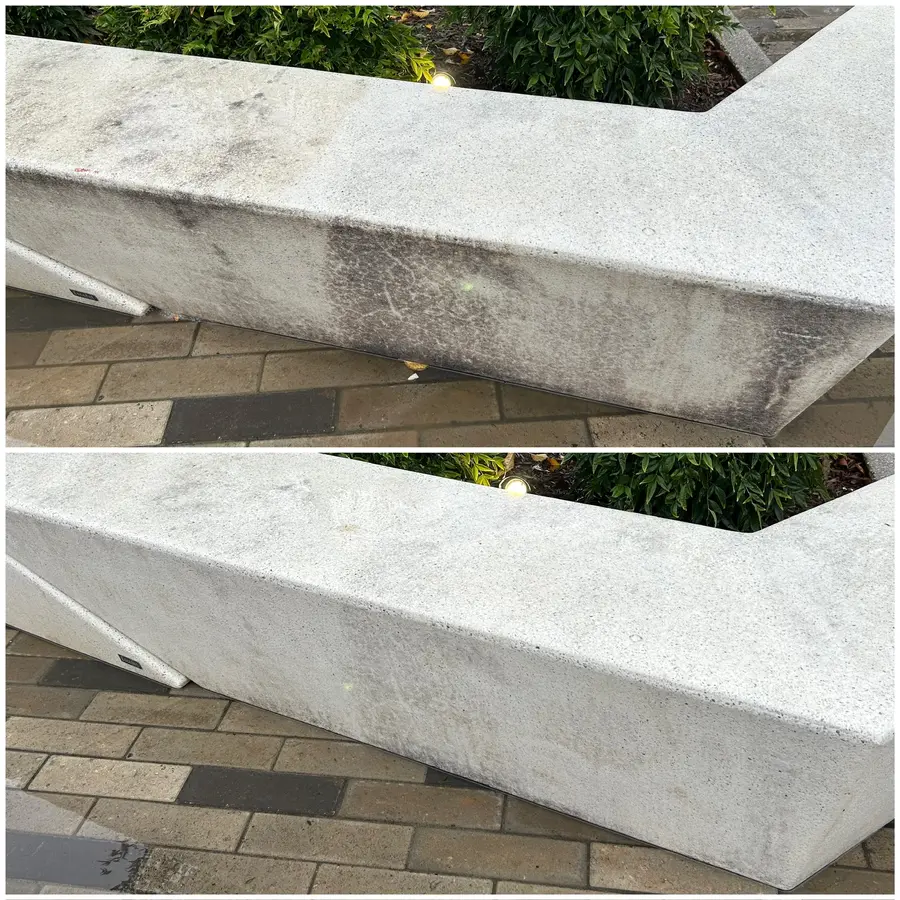
| Concrete entries and walkways | Every building type | Surface cleaner, higher pressure tolerated |
| Awnings and canopies | Retail entrances, restaurant fronts | Soft wash, hand scrubbing on stubborn buildup |
EIFS and stucco are the surfaces that cause the most damage when a vendor gets it wrong. The finish coat on EIFS is thin, sometimes less than a sixteenth of an inch, and it sits over a foam insulation layer that was never designed to get wet from the outside. High pressure punctures that finish coat, water gets behind it, and the foam holds moisture against the building’s structural sheathing. That damage does not show up the day of the wash. It shows up months later as a soft spot, a stain bleeding through, or in the worst cases, active rot inside the wall. We treat EIFS and stucco with the same caution regardless of how dirty it looks, because the risk is the same either way.
Brick and concrete block are a different story. Both can take real pressure, and the mortar joints are usually the limiting factor rather than the brick face itself. Older mortar, especially anything original to a pre-1960s building, is softer than modern mortar and erodes faster under sustained pressure, so we adjust pressure and standoff distance based on the age and condition of the joints, not just the brick.
Maintenance contracts and what a recurring schedule looks like
A one-time wash gets a dirty building clean. A maintenance contract keeps it that way, and it is usually the more cost-effective option for a property that gets dirty on a predictable cycle. Common structures we set up for commercial clients:
- Annual full-exterior wash. Every surface, every elevation, once a year. Works for buildings with moderate soiling and no unusual tree cover or moisture problems.
- Semi-annual wash with an entry-focused interim visit. A full wash once a year, plus a lighter visit at the six-month mark that focuses on entries, storefronts, and any area with heavier foot traffic or visible buildup.
- Quarterly entry and storefront service. For retail properties where the entrance is the whole first impression, a quarterly visit keeps glass, trim, and the immediate entry area presentable between full washes.
None of these require a long-term commitment to start. We can run a single job first, see how the building holds up, and set the interval based on what you actually observe rather than a schedule picked in advance.
Why exterior condition shows up in your leasing numbers
A dirty exterior is not just a cosmetic issue for a commercial property, it is a leasing and tenant retention issue that shows up in numbers a property manager actually tracks. A prospective tenant touring a building forms an impression of the whole property from the exterior before they see a single suite, and a stained facade or grimy entry reads as deferred maintenance, whether or not the interior is well kept. That impression carries into lease renewal decisions too. A tenant renewing a lease is weighing the whole experience of the property, and a building that looks maintained signals a landlord who invests in the asset, which matters more at renewal time than most owners give it credit for.
There is also a liability dimension that goes beyond the wash itself. Algae and mildew buildup on walkways and entries, especially in shaded areas, create a slip hazard that turns a cosmetic problem into a real claims exposure. A slip-and-fall incident tied to a visibly neglected walkway is a harder position to defend than one where the property has a documented maintenance history. Keeping exteriors on a regular schedule is one of the more straightforward ways to reduce that specific risk, and it costs a fraction of what a single claim can cost in legal exposure and insurance impact.
Managing the vendor relationship, not just the wash
Bringing any vendor onto a commercial property carries risk beyond the quality of the work itself. A vendor without proper insurance, without a clear scope of work, or without a predictable schedule creates its own kind of exposure, gaps in coverage if something goes wrong on site, confusion over what was actually included in a quote, and disruption when a job runs long or gets rescheduled without notice.
We manage that relationship the way a property manager actually wants a vendor managed. Certificate of insurance provided before the first visit, not after a request. A written scope that matches what gets quoted, so there is no ambiguity about what a walkway wash versus a full building wash includes. A schedule that respects your building’s hours and gets confirmed in advance rather than showing up as a surprise. None of this is complicated, but it is the part of vendor management that a lot of pressure washing companies treat as optional rather than standard.
What moves the price on a commercial job
Every commercial building is different enough that a flat per-job number does not tell you much. What actually drives the cost:
Square footage and story count set the baseline, since they determine how many hours the crew needs on site and whether ground-based equipment reaches every elevation or a lift becomes necessary. The mix of siding materials matters just as much as total area, because a building that is half EIFS and half brick takes longer than an all-brick building of the same size, since the EIFS sections move slower under soft wash treatment. Degree of soiling changes the picture too. A north-facing wall under tree cover that has not been washed in two years takes meaningfully longer than a south-facing wall washed annually. Access is the last major factor. If every elevation is reachable from the ground, the job moves faster than one where a lift or additional equipment is required to reach upper floors safely.
We walk the property, note the surface mix and access situation, and give you a number before any work starts, along with what is driving that number so it does not feel arbitrary.
What goes wrong when a vendor skips the walk-through
The most common mistake we see on commercial buildings that have had a bad experience with a previous vendor is a crew that shows up and starts washing without first identifying where EIFS meets brick, where a previous repair patch sits, or where a downspout or roof drain discharges onto a lower wall section. Any of those details changes how a section should be treated, and missing them is how a building ends up with a section that looks streaky, a patch that peels, or a wall that stays damp longer than it should after the crew leaves.
We walk every commercial building before starting, not as a formality but because that walk is where we catch the details that change the plan. A hairline crack in stucco that needs a lighter touch. A section of brick that was repointed recently and has mortar still curing. A storefront sign with a finish that needs hand cleaning instead of a rinse. None of this takes long to identify, but skipping it is exactly how avoidable damage happens on commercial properties, and it is why we build the walk-through into every quote rather than treating it as optional.
What to expect on the day
A crew arrives at the scheduled time, whether that is a Tuesday morning or a Sunday at 2am for a 24-hour retail location. We walk the exterior first to confirm surface types and flag anything unusual, like a section of stucco that already shows cracking or a storefront window with a film that needs hand detailing rather than a rinse. EIFS, stucco, and painted surfaces get soft washed. Brick, block, and concrete get pressure-washed with a surface cleaner where flat area allows it. Storefront glass and trim get a hand pass. We manage runoff away from storm drains where the site layout allows it, and we clean up before leaving so there is no equipment or debris sitting on your property after the crew is gone.
Call 980-888-8283 to schedule a walk-through and get a number for your building, or reach out through Rolling Suds of Northeast Charlotte or Rolling Suds of West Charlotte depending on where your property sits.